
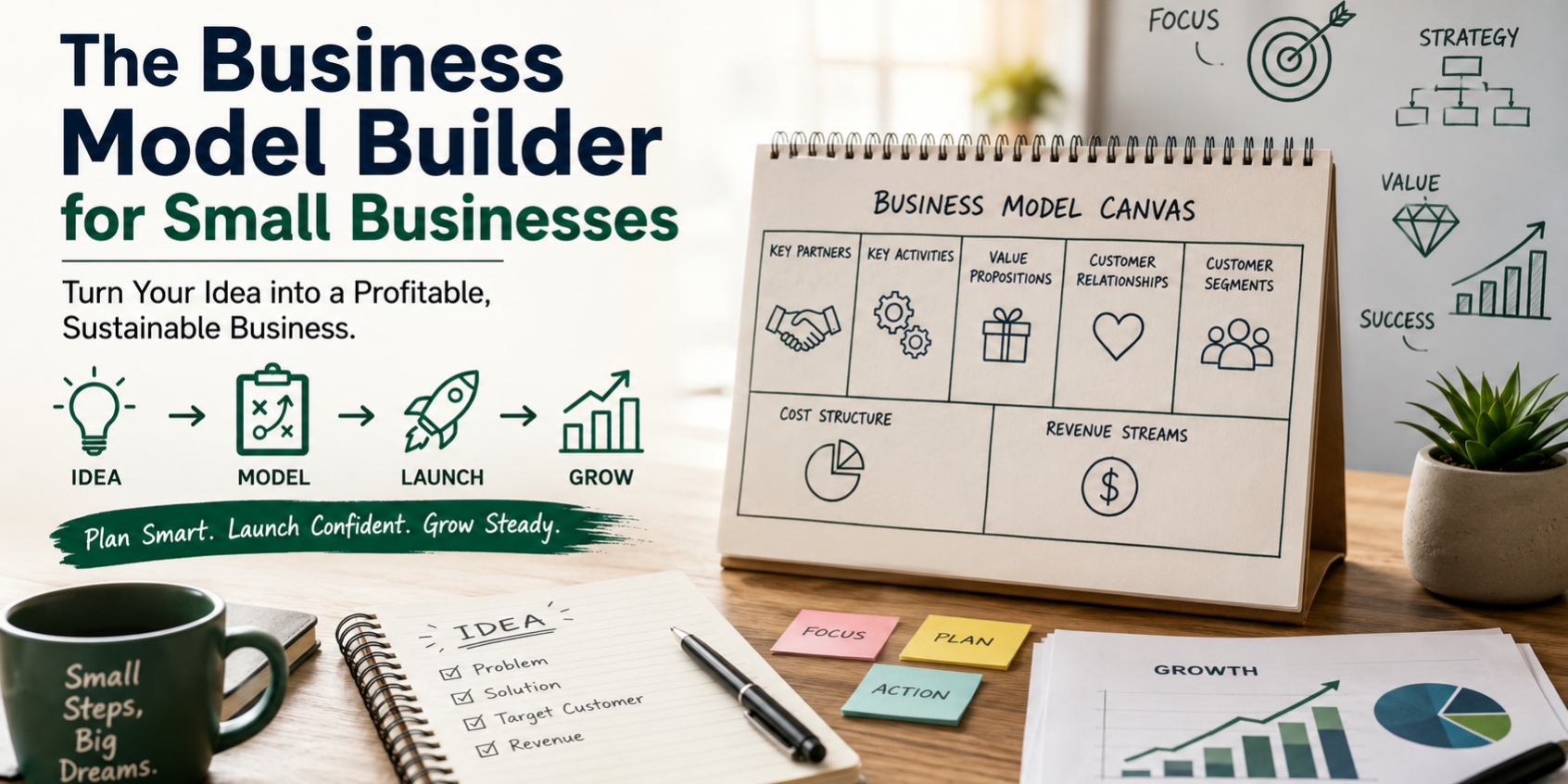
The Business Model Builder for Small Businesses
Why You Need a Model — First Thoughts
You’re starting your own business because you have an idea, or passion, or dream. And that’s great! Ideas are the spark; models make them grow into something real. But here’s the catch: many small businesses fail not because they don’t have ideas, but because they can’t take the next step — from idea to plan, from plan to launch.
The Three Reasons Your Idea Might Fail
- No money: You’ve got a great idea, but you’re broke. Without a clear way to earn money, your business is doomed.
- No plan: You think you can figure it out as you go? Business is not about solving problems; it’s about avoiding big ones. A model shows you the risks ahead of time.
- No focus: Your idea has 100 possible paths — but how will you pick just one? A model helps you narrow down to your top ideas.
The Model Is Not About Being Perfect
It’s not about creating a business plan that looks like something from a university coursebook. It’s about having an honest conversation with yourself:
- What problem does this solve?
- Who will buy it?
- Why are the other 50 ideas in your industry failing?
- What makes my idea different?
The answers won’t be perfect — they should never be perfect. But by asking these questions, you’ll get enough information to decide whether your business is worth starting in the first place.
The Model Is Not About Being an Expert Either
It’s not about knowing how businesses really work; it’s about figuring out what works for your idea. Most entrepreneurs start with what they think they should be doing, based on someone else’s model. You’re building from scratch — that means you need to create the whole thing, model and all.
You might worry: “This is too hard; I just need to figure it out as I go.” Businesses fail 90% because owners don’t take small steps to make models.
Building a Business Model in 10 Minutes — One-Sheet Idea Generation
The Idea That Won’t Leave Your Desk
First business models are never perfect, but a bad idea still beats silence and fear. Take five minutes with your worst idea:
- What problem does it try to solve?
- For whom is it solving this problem (who’s in the market)?
- How will you get 1 customer? One transaction?
A one-sentence summary is all you need. It’s a testable claim, not an operational plan. Write it on the back of your hand.
The One-Page Framework
Now build upon that idea with these four questions:
| Problem Answer | Customer Profile | Revenue Path | Unique Sales Touchpoint |
| How does this problem hurt customers? | Who’s struggling and why? What’s their income, pain level? | What kind of money are they spending? Where? | At what point do the costs switch from ‘avoiding’ to ‘paying’? |
The Sticky Bits
Identify the first two columns you want to pay for more:
- Customer profiles: Are you describing a group of people who feel like customers? Should your marketing speak to them?
- Revenue paths: Is it credit card payment that hurts margins? Can it be a monthly charge with fewer disputes?
The idea generates its own sticky bits; the model is not yours until they are.
Choosing Your Products or Services — The Two-Page Framework
Selecting a product or service for your business can be daunting because it impacts everything from pricing to marketing messaging, customer complaints to supply chain logistics. However, getting it wrong early on costs more than any other mistake, including hiring the wrong team.
A simple two-page framework can guide you through the decision-making process:
The Two-Page Framework
| Side 1: What’s In? | Criteria for products/services |
| Why are we in this market? (SWOT) | Is our unique selling proposition clear? Does it cover both advantages and disadvantages of the product/service? |
| How do these ideas match my customers? | Are there any specific pain points or benefits from direct experience that don’t show up on a website or brochure? Do they have one budget, one voice, and one way to complain? |
| Side 2: What’s Out? | Rules for eliminating or holding off |
| Cost of entry vs. cost of exit (how much money would we spend to take it out?) | Are there hidden expenses like insurance premiums that none talks about until you’re in the trenches? Does this opportunity have enough risk to justify being taken out?
| How do these ideas intersect? | Do they create dependency on another business’s supply chain? Is there any one product/service that, if removed, makes everyone else’s work useless?
For each idea listed on Side 1:
- ask Side 2 questions
- score everything from ‘it has to happen’ (10) down to ‘I don’t care about the potential for it’ (1)
- add up your scores — you should only keep ideas that scored at least 7, because a business model with too many small opportunities isn’t big enough.
What keeps you in this market? Is it passion, profit, or something else entirely?
How to Make Money from Ideas — Pricing Without Margin Testing
Pricing is where most ideas go to die: you’re either too cheap, too expensive, or nobody understands your cost structure enough to pay what you need.
The Rule of Three Pricing Tests
- Cost vs. Value: Sell at the lowest price customers are willing to pay for value, and charge per unit (e.g., a bottle of water). Sell at the highest price they’d pay for the same thing (or something very similar), and sell by volume (e.g., soda fountain).
- The Five-Price Experiment:
- Sell one product with five different prices — $0, $5, $10, $20, and ‘whatever you think it’s worth’ — see what sticks.
- Take the cheapest price that sold, and charge that for every product.
- Keep track of price elasticity (the percentage change in sales when the price moves). Stop testing at the end of the month.
Why It Works
- Pricing tests are data points you’d never have from customers alone: ‘Your prices make me hate your brand more than my own family does.’
- You test the whole market, not just one customer’s willingness to pay twice.
Why Your Product Sells Only Partly — Identifying the Sticky Bits
The main reason your product doesn’t sell as much as you think it should: there’s a sticky bit in its design, pricing, or delivery that turns customers off before they even reach checkout.
To identify your sticky bits, follow these steps:
- Buy your own product. Be honest with yourself — what do the packaging say? The sales page read? What does the price look like?
- Read 100 comments on a product’s online discussion forum. (Don’t worry about other forums; this one works for all types.)
- Go to social media platforms and find your product mentioned in 5 different posts. How many of them have the exact same complaint?
Your sticky bits can be one or more of these:
- The price is a surprise:
- The unit price on eBay costs $10, but the actual cost at checkout will be higher.
- You’re offering two prices: the “one-time” fee and the monthly subscription — which you’ve actually decided to charge monthly anyway.
If your price looks like a joke, no one’s going to take you seriously. The price should look like a real number; it should have a unit (dollars or euros), and it should be clearly stated up front.
- The delivery is the problem:
- Free shipping only works for orders over $50 — what about people who are buying smaller stuff?
- The packaging doesn’t look professional, so your product will die in the hands of your customers.
If there’s a one-step change that could make your product more convenient and more attractive to repeat buyers, take it.
Designing Your Sales Experience — From Idea to First Sale
You’ve created your product or service, but customers aren’t showing up at the door — yet. The biggest sales barrier isn’t features or price; it’s how you’re selling.
Why Your Product Sells Only Partly
If only 20% of your sales happen from direct marketing (and even that is mostly because you’ve already sold to their friends), why are you spending all your time on that? There must be another channel — or a variation on your current one — where customers are actually showing up.
Identifying the Sticky Bits
The 5 channels where most of your sales come from are:
- Social media
- Word-of-mouth (referrals)
- Online advertising
- Events (trade shows, workshops)
- Your website
- Ask yourself: Where do I usually get my first sale?, and then:
- Count the referrals — If 70% of sales come from friends who’ve bought already, that’s a whole marketing channel waiting for you.
- Advertise where they are online — Social media channels where your customers buy aren’t always the same ones where you post (e.g., Instagram vs. Facebook).
The One-Page Sales Canvas
A simple canvas with 5 columns:
| Channel | Why Customers Come Here? | What You Sell? | At What Price? | Marketing Strategy |
| Social media | They buy on Instagram, not Facebook. | Your photo album. | $100, no payment plan. | 10% commission ad spend. |
| Workshop | People attend your workshops; they’re there to see products in action. | The product demo, plus a gift bag for buying afterwards. | Free, with the promise of discounts online. | Half-day workshop with drinks included. |
First Sale Strategy
You won’t get 100 sales in one day — but you can get that first sale on the launch day by:
- The ‘First Buyer’ Offer: Discount for the first buyer who brings a friend — people tell their friends at conferences, and the offer comes with free publicity.
- Live Onstage — sell from the stage: the show has built 500 people’s interest already; they just need to buy.
The First Sale Checklist
- You’ve got a single product idea you can sell today (no variations).
- Your ‘first sale’ price is below cost — it needs a discount or a payment plan.
- You have a marketing channel ready for the launch day: social media, email, your blog.
Creating a Marketing Plan for Launch Day — No Strategy Required
Small businesses fail before they even launch, not because their ideas are bad but because nobody knows about them when it’s time to buy. Your marketing plan for launch day isn’t supposed to be long-term; it’s just long enough to get customers into your store or onto your website.
The First Step: What You Already Have
You own a credit card, a phone number, and a social media account that nobody follows except you. These are the three essentials any business needs on day one:
- A way to accept payments
- An address people can visit
- A public profile of who you are
The Second Step: One Simple Message
Write down exactly what you’re selling for launch day, and why it matters to your target customers. Keep this message in short form because everyone’s attention is short on launch day:
- What product?: Your phone case design (not ‘phone cases’).
- Why it matters: It’s custom-printed, so the kid who gets it won’t be bored for five years.
The Third Step: Where You Will Sell
You can only sell what you know how to make. For most small businesses, that means:
- Your physical store
- Online shop linked to your phone number
- Two or three third-party sellers with a contract
The Fourth Step: When You Will Launch
The moment of truth must be live because the window between announcement and launch is long enough for people to forget. Choose one day and stick to it, with the same message for every announcement:
- Announcement times are often 9 am or 5 pm when most people stop work.
- Make your announcement time exactly what you’re selling; don’t say ‘launches Friday’ if that’s Wednesday.
The Fifth Step: One Number That Tells You It Works
The one number you really care about on launch day is your first sale. For every sale, measure:
- Time to sale (hours)
- Revenue per unit sold
- How many sales it took to get the first five
You’ve built a model in 10 minutes; now you’re selling it at price zero — but that’s where the magic happens first.
Measuring Growth on One Number — Before Data Points Take Over
When starting out, it’s easy to get lost in a sea of metrics: website traffic, email open rates, conversion percentages. These numbers can feel like a puzzle with missing pieces — and before you know it, the puzzle has moved from your living room to your office attic.
You don’t need all those pieces; one number tells you everything:
- Your monthly recurring revenue is your growth number.
Why?
- One metric for everything: Your business either makes money or loses money every month. A single number shows both ends clearly.
- No noise from other channels: Email open rates signal engagement, but if nobody pays the bill, it doesn’t matter how many emails you sent — yet. Website traffic might look great on a Tuesday afternoon but disappears at midnight; your monthly recurring revenue doesn’t care about those fluctuations.
How to track this one number?
Step-by-Step:
- Track every customer sale: Your invoicing system is already set up for payments, not customers. If you’re using an accounting tool (like QuickBooks), it’s likely counting invoices as income — your main business metric.
- Keep the number public: Share your monthly recurring revenue on your website or social media accounts. Why? It acts as a clear goal and signal to your real users, who will either step up to meet that goal or move away.
Why this one number matters most?
Your first $1,000 in recurring revenue might feel like a miracle — but it’s not the endgame. The business model is just one piece of the puzzle; growth happens from there. Without knowing whether you’re getting closer to profitability, every decision feels like a gamble.
How long does this number give you?
A good monthly recurring revenue target for small businesses should be:
- $2,000 per month for the first 6 months (you don’t have enough sales or cash flow yet)
- $3,500 per month in months 7-12 (your business has some traction; the real growth is now)
If your monthly recurring revenue jumps to $10,000 after just one year? That’s not a success story — that’s a warning sign: You’ve got a customer retention problem.
The Exit Checklist: Turning from Business Owner to Business Investor
You’ve built something that pays, customers love it, and you’re proud of what you’ve done. But being an entrepreneur isn’t a permanent position; either you get hired by someone else or you sell to another business. Either way, the skills you learned building your own model will get you through either exit.
Preparing Your Model for Sale
Before you start looking at buyers:
- Document everything: Write down how every customer interacts with your model. Where they sign up, why they cancel, what they pay per month — all of it.
- Get exact numbers:
- Revenue by quarter
- Customer count by segment
- Average retention time
- Identify the unique part: What’s unique about your model? Is it your pricing strategy or your customer support process?
Identifying Buyers
You can’t sell what nobody wants to buy, so you need to figure out who the buyers are:
- Identify your competitors’ weaknesses:
- Who else offers exactly what I do?
- Why is my service cheaper/better than theirs?
- Research existing models’ histories:
- What did they sell for? To whom? How many customers did they have?
- Create a list of potential buyers:
Preparing Your Pitch
The model itself is the most valuable thing you’ve built, but it’s not enough to sell. You need an argument for why someone should buy your entire business at all:
- Don’t pitch features; sell benefits:
- ‘Our model reduces churn by 90% and increases revenue per customer by 50%’
- ‘Your team can grow faster because our model supports customers, not the other way around’
- Show traction:
- Revenue numbers
- Customer retention rates
- Any awards or recognition your business has received
The Exit Conversation
You’re now ready to talk business with a potential buyer:
- Start with a summary pitch: ‘Our model generates 10x monthly revenue and reduces churn by 90% — that’s why we want to sell.’
- Answer their questions:
- How will they integrate it into their operations?
- What support team will be assigned?
- What is the timeline for integration?
This checklist gets you from building a model to selling your business. It takes the guesswork out of where to start and how much money you can expect, but no two sales are ever alike.
Conclusion: You’ve Got It Now, Don’t Lose It
You’re done building your business model. Now you have a living, breathing document that you can refer back to whenever confusion strikes. And yet, here’s where the real challenge begins: keeping it alive.
What Every Business Owner Needs — But Nobody Remembers to Do
- Write down the one reason you started this business today, in your own words. Why did you build a bakery instead of buying cake?
- Mark every time someone asks that question. You’ll see patterns emerge, and those are the problems worth fixing next.
- Commit to checking your model once a month. It’s an automatic habit at scale; start now.
How to Make Model-Keeping Automatic
- Design it as part of your first 100-day calendar. Meeting new customers is a one-size-fits-all opportunity; keeping the business running in those early months requires discipline and routine.
- Make model-checking into a daily email with yourself, no matter how long the report takes. The habit is everything.
Why It Won’t Stick Unless It’s Used
Business models become plans for someone else — usually an investor, not you. Use yours to:
- Create a weekly market list — the one place where your model becomes actionable.
- Keep track of every mistake made and how it was fixed, in the same report. Why did the oven fail? Fixing is just as important as predicting.
The One Sentence You Should Be Defending
You can’t sell because you don’t have a price for nobody; but you can check your model regularly to know why that’s true, at any moment. That sentence should come up in meetings with investors, partners, or even family members.





Your site’s position in the search results http://fertus.shop/info/